Safeguarding Policy
1. Introduction
Safeguarding is ‘everyone’s business’. This policy sets out MindMosaic Counselling and Therapy’s (MindMosaic) responsibilities under the Protection of Children (Scotland) 2003, Children (Scotland) Act 1995.
2. Purpose
2.1. The purpose of this policy and the associated procedures is to protect and promote the welfare of the children, young people and adults at risk using or receiving services provided or commissioned by MindMosaic and to support MindMosaic, its staff, trustees and volunteers in fulfilling their statutory responsibilities. MindMosaic is not a statutory service, and it is not the role of a charity to investigate allegations of abuse. However, all trustees, employees, volunteers and contracted services providers have a clear responsibility to take action when they suspect or recognise that a young/vulnerable person at risk may be a victim of significant harm or abuse in addition, MindMosaic has a responsibility to ensure that it provides an environment which minimises the risks of preventable harm and working practices which protect people at risk.
2.2. This policy demonstrates how MindMosaic will meet its legal obligations and reassure service users, trustees, employees, volunteers and those working on behalf of MindMosaic:
About what they can expect MindMosaic to do to protect and safeguard children, young people and adults at risk.
That they can safely voice any concerns through an established procedure.
That all reports of abuse or potential abuse are dealt with in a serious and effective manner.
That there is an efficient recording and monitoring system in place.
That trustees, employees, volunteers and contractors delivering services to children young/vulnerable people receive appropriate training.
That robust ‘safer’ recruitment procedures are in place and vetting of staff in compliance with Disclosure Scotland.
2.3. Individual local authorities have the responsibility for the protection of children, and this responsibility is monitored through Child Protection Committee’s in Scotland. MindMosaic has a duty to ensure that it operates effective practice in this regard.
2.4. MindMosaic must carry out its responsibilities by ensuring that the needs and interests of children, young people and adults at risk are considered by all trustees, employees, volunteers and contracted services when taking decisions in relation to service provision.
3. Policy Statement
MindMosaic is committed to safeguarding children, young people at risk from abuse when they are engaged in services organised and provided by, or on behalf of MindMosaic.
MindMosaic will:
Endeavour to keep service users and young volunteers safe from abuse or neglect. Suspicion of abuse or neglect will be responded to promptly and appropriately. We will always act in the best interests of the child or young person at risk.
Proactively promote the welfare and protection of all children young people and vulnerable adults at risk who access services from MindMosaic.
Ensure that unsuitable people are prevented from working with children young people and vulnerable adults at risk through robust ‘safer recruitment’ procedures and guidelines for the management of volunteers.
Deal with any concern raised by a trustee, employee, volunteer, contracted service provider, or service user promptly, appropriately and sensitively.
Accept safeguarding referrals made by a trustee, employee, volunteer or contracted service provider and ensure that they are aware that they cannot be anonymous and that during enquiries a referrer may be required as prosecution witness.
Not tolerate harassment of any trustee, employee, volunteer, contracted service provider or child, young person or vulnerable adult at risk who raises concerns of abuse or neglect.
Work in co-operation with local authorities, the police, Local Child Protection Committee’s and will make appropriate changes and amendments to improve safeguarding policies and procedure as needed.
Prevent abuse by using good practice to create a safe and healthy environment and avoid situations where abuse or allegations of abuse could occur.
Ensure there are appropriate governance structures in place to monitor safeguarding activity, to learn from safeguarding data and events and to make improvements to safeguarding policy, procedure and practice.
4. Scope
4.1. This policy covers all trustees, employees and volunteers at MindMosaic, as well as contracted service providers.
4.2. Safeguarding Roles and Responsibilites
4.3. Board of Trustees
Trustees have a legal duty to take reasonable steps within their power to ensure that children young people and vulnerable adults that come in contact with the charity are safeguarded from harm. The Board delegates the day-to-day implementation of this responsibility to the senior management team in the roles described below.
4.4 Designated Safeguarding Lead (DSL)
MindMosaic has appointed Designated Safeguarding Leads (DSLs) with responsibility for overseeing safeguarding practice, receiving safeguarding concerns and ensuring appropriate action is taken in line with this policy and statutory guidance.
Current Designated Safeguarding Leads
Lead DSL: Gwyneth MacDonald, Chief Executive Officer
Deputy Lead: Elaine Wroe, Director of Counselling
Additional Safeguarding Contact (if Lead and Deputy unavailable): Senior Counsellor on Duty
Safeguarding Contact Details
Email: safeguarding@mindmosaic.co.uk
Telephone: 01475 892208
Contact details for the Designated Safeguarding Leads are published on the MindMosaic website and must be known to all trustees, employees, volunteers and contracted service providers.
If a safeguarding concern involves a Designated Safeguarding Lead, the matter must be escalated to an alternative DSL or reported directly to the relevant statutory agency.
4.5 Disclosure Scotland/PVG
Directors of Service must ensure that employees and volunteers are subject to appropriate Disclosure Scotland checks and that their staff and volunteers comply with these policies and related procedures.
5. Safeguarding Reporting Procedures
5.1. Introduction
This section sets out the safeguarding reporting flow to be followed by all trustees, employees, volunteers and contracted service providers where there is concern about the welfare or safety of a child, young person or adult at risk.
MindMosaic is not a statutory investigating body; however, everyone working for or on behalf of MindMosaic has a duty to recognise safeguarding concerns, report them promptly and record them accurately.
5.2. Immediate Risk
If a child, young person or adult at risk is believed to be in immediate danger, or if a crime is in progress:
Emergency Services must be contacted immediately by calling 999.
The concern must then be reported to the Designated Safeguarding Lead (DSL) as soon as it is safe to do so.
5.3. Reporting a Safeguarding Concern – Internal Process
Step 1: Raise the concern immediately.
Any safeguarding concern, disclosure or allegation must be reported without delay to the Designated Safeguarding Lead (DSL).
Concerns must not:
Be investigated by the person raising them.
Be delayed.
Be treated as confidential beyond safeguarding limits.
If the Lead DSL is unavailable, concerns must be reported to the Deputy DSL or, if unavailable, the additional safeguarding contact outlined in Section 4.4.
5.4. Recording Safeguarding Concerns
Step 2: Written record
The individual who observes, receives or becomes aware of a safeguarding concern must complete a Safeguarding Incident Record Form as soon as possible and wherever practicable within the same working day.
Records must include:
Date, time and location.
Factual details of the concern or disclosure (using the individual’s own words where possible).
Any immediate actions taken.
Name and role of the person completing the record.
All records must be stored securely and in line with data protection legislation.
5.5. Safeguarding Lead Actions and Decision-making.
Step 3: Assessment and response
The Designated Safeguarding Lead will:
Assess risk and immediate safety.
Consider consent, confidentiality and information sharing requirements.
Determine appropriate action in line with local and national safeguarding guidance.
Record decisions, actions taken and the rationale for those decisions.
5.6. External Reporting and Escalation
Step 4: Referral to statutory agencies
Where a concern meets the threshold for statutory intervention, the Designated Safeguarding Lead will make a referral without delay to the appropriate agency, which may include:
Local Authority Children’s or Adult Protection Services (Health & Social Care Partnership).
Police Scotland.
Consent will normally be sought unless doing so would place the individual or others at increased risk or compromise safeguarding enquiries.
5.7. Allegations Against Trustees, Employees, Volunteers or Contractors.
Where a safeguarding concern involves a trustee, employee, volunteer or contracted service provider, the Designated Safeguarding Lead will:
Take immediate protective action where necessary.
Ensure the individual concerned is not involved in managing the concern.
Make statutory referrals where appropriate.
Follow MindMosaic’s managing allegations and disciplinary procedures.
5.8. Follow-up, Monitoring and Governance
Step 5: Ongoing oversight
The Designated Safeguarding Lead will:
Monitor safeguarding concerns and outcomes.
Ensure appropriate support is offered.
Identify learning to inform supervision, training and policy review.
Provide safeguarding summary reports to the Board of Trustees.
5.9. Escalation and Whistleblowing
If a safeguarding concern involves a Designated Safeguarding Lead, or if an individual believes a concern has not been addressed appropriately, concerns may be escalated to:
An alternative Designated Safeguarding Lead, or
The relevant local authority safeguarding team or Police Scotland
MindMosaic will not tolerate any detriment or retaliation against individuals who raise safeguarding concerns in good faith.
6. Recruitment
MindMosaic is committed to safer recruitment procedures. Full details are included in the MindMosaic Recruitment and Selection Process. Where it is identified that services or staff have regular or frequent contact with children, young people and adults at risk then appropriate procedures are initiated by the recruiting Manager.
7. Training and Induction
MindMosaic will provide:
Mandatory training: at induction for all staff and volunteers.
Enhanced training: for those roles whose primary task is working directly with children, young people and vulnerable adults.
Managerial support and supervision: to all staff dealing with the complexities that arise from working with children and adults at risk.
8. Monitoring and Evaluation
The Safeguarding Lead will monitor all safeguarding incident reports to ensure that appropriate action has been taken. A summary report will be made available to the board. The Safeguarding Lead will present an annual report to the Board assessing the effectiveness of the policy and recommending whether additional actions are required at an organisational level to make it more effective.
9. Links to Other MindMosaic Policies and Procedures
All staff and volunteers need to be mindful and aware of other policies and procedures within Mind Mosaic that support their work and contribute to safeguarding children and adults at risk.
Appendix 1 Definitions
Definitions of abuse:
Abuse and neglect are forms of maltreatment of a child or adult at risk. Somebody may abuse or neglect a child or adult at risk by inflicting harm, or by failing to act to prevent harm. Children or adults at risk may be abused in a family or in an institution or community setting, by those known to them or, more rarely, by a stranger for example, via the internet. They may be abused by an adult or adults, or another child or children.
Physical abuse:
Physical abuse may involve hitting, shaking, throwing, poisoning, burning or scalding, drowning, suffocating, or otherwise causing physical harm to a child or adult at risk. Physical harm may also be caused when a parent or carer fabricates the symptoms of, or deliberately induces, illness in a child or adult at risk.
Emotional Abuse:
Emotional abuse is the persistent emotional maltreatment of a child or adult at risk such as to cause severe and persistent adverse effects on the person’s emotional development. It may involve conveying to children or adults at risk that they are worthless or unloved, inadequate, or valued only insofar as they meet the needs of another person. It may include not giving the child or adult at risk opportunities to express their views, deliberately silencing them or ‘making fun’ of what they say or how they communicate. It may feature age or developmentally inappropriate expectations being imposed on children or adult at risk. These may include interactions that are beyond the child’s or adult at risks developmental capability, as well as overprotection and limitation of exploration and learning, or preventing the child or adult at risk participating in normal social interaction. It may involve seeing or hearing the ill treatment of another. It may involve serious bullying (including cyber-bullying) causing children or adult at risk frequently to feel frightened or in danger, or the exploitation or corruption of children or adult at risk. Some level of emotional abuse is involved in all types of maltreatment of a child or adult at risk, though it may occur alone.
Neglect:
Neglect is the persistent failure to meet a child or adult at risk’s basic physical and/or psychological needs, likely to result in the serious impairment of the child or adult at risk’s health or development. Neglect may involve a parent or carer failing to:
Provide adequate food, clothing and shelter (including exclusion from home or abandonment).
Protect a child or adult at risk from physical and emotional harm or danger.
Ensure adequate supervision (including the use of inadequate caregivers).
Ensure access to appropriate medical care or treatment.
Be responsive to a child or adult at risk’s basic emotional needs.
Sexual Abuse:
Sexual abuse involves forcing or enticing a child or young person to take part in sexual activities, not necessarily involving a high level of violence, whether or not the child is aware of what is happening.
The activities may involve physical contact, including assault by penetration (e.g. rape or oral sex) or non-penetrative acts such as masturbation, kissing, rubbing and touching outside of clothing.
They may include non-contact activities, such as involving children or adult at risk in looking at, or in the production of, sexual images, watching sexual activities, encouraging children or adult at risk to behave in sexually inappropriate ways, or grooming a child or adult at risk in preparation for abuse (including via the internet).
Sexual abuse is not solely perpetrated by adult males. Women can also commit acts of sexual abuse as can other children.
Abuse of trust
A relationship of trust applies to trustees, staff and volunteers in a position of power or influence over a person who is attending their setting. This could mean someone who provides training, supervision or is in sole charge of a person. The ‘person’ could be someone who is under 18 years, or who is over 18 if considered to be ‘an adult at risk’, e.g. they have a learning disability or mental ill-heal.
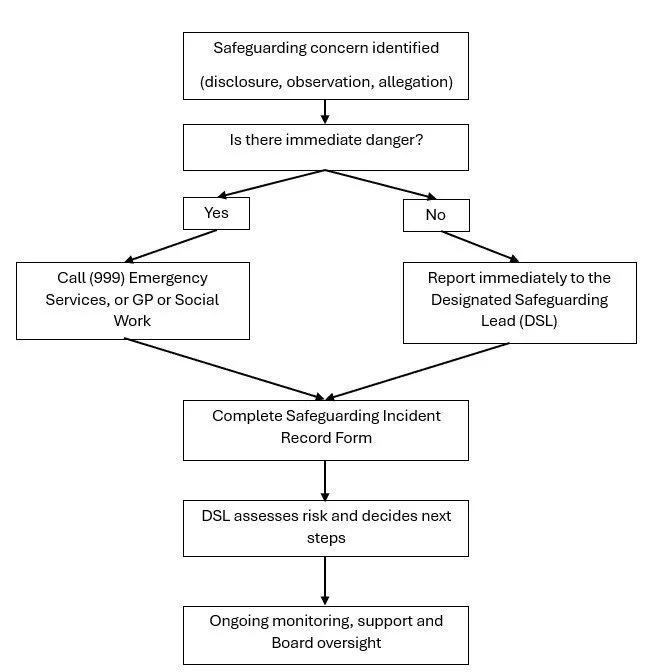
Appendix 2 – Safeguarding Report Flowchart
This appendix provides a visual summary of MindMosaic Counselling and Therapy’s safeguarding reporting process for children, young people and adults at risk. Full procedural detail is set out in Section 5 of the Safeguarding Policy.